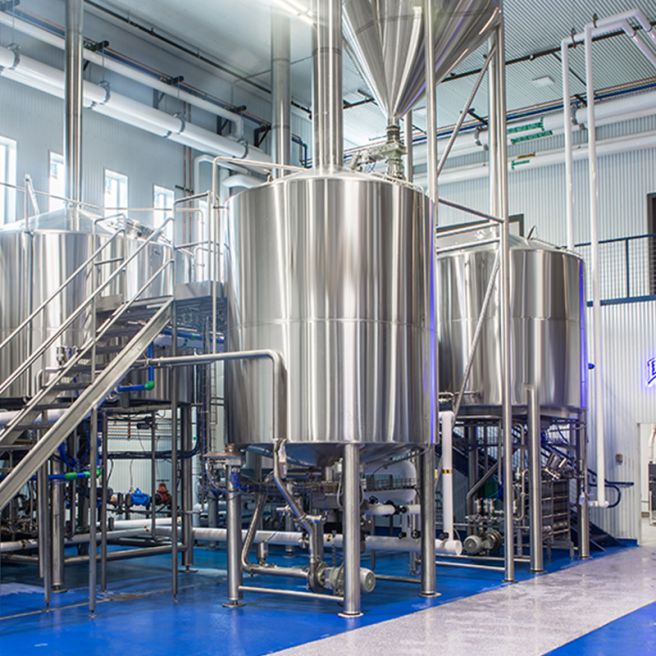
The right brewhouse should be sized from weekly sellable-beer volume, fermentation capacity, brew length, recipe mix, labor hours, and available utilities rather than vessel capacity alone. In the United States, 1 BBL equals 31 gallons, so a nominal 10 BBL batch represents 310 gallons before process losses. A brewery needing 100 BBL per week may require ten 10-BBL brews, five 20-BBL brews, or another schedule depending on cellar size. Brewhouse efficiency, cleaning time, heating rate, and fermentation occupancy alter that calculation. A correctly sized system balances batch volume with the number of brews the cellar and staff can actually process each week.
Start with finished-beer demand rather than annual brewhouse capacity. A brewery selling 5,000 BBL per year across 50 operating weeks averages 100 BBL per week. With a 10 BBL brewhouse, ten theoretical batches are needed. If the operation loses 8% of volume through trub, transfers, samples, tank bottoms, and packaging, about 109 BBL of wort-related production may be needed to support 100 BBL of packaged beer. The exact loss rate should come from the brewery's own production records rather than a generic allowance.
That calculation becomes more useful when batch frequency is added. A 10 BBL system completing one batch in 7 hours produces roughly 10 BBL per brewing shift; shortening the interval between mash-ins to 4.5 hours may allow two turns during an extended production day. A brewery planning 500 brew days over several years should care about saving 30 minutes per turn because 30 minutes × 500 batches equals 250 operating hours.
A brewhouse that looks inexpensive per barrel can become expensive per packaged barrel when every batch requires extra labor, long heating periods, or repeated manual transfers.
Cellar configuration should therefore be reviewed immediately after estimating brew frequency. A brewery with a 10 BBL brewhouse and six 20 BBL fermenters can double-batch into each fermenter. Filling one vessel requires about 620 gallons at nominal volume because 20 BBL equals 620 U.S. gallons. A cellar containing 10 BBL fermenters instead requires twice as many tanks to hold the same 120 BBL of nominal fermentation capacity. TTB uses 31 U.S. gallons as one beer barrel for beer measurement and reporting.
Fermentation time changes usable cellar capacity further. If an ale occupies a tank for 14 days, a fermenter may theoretically complete about 26 cycles in a 52-week year before cleaning, scheduling gaps, and conditioning time are considered. A lager occupying the same tank for 28 days falls to about 13 theoretical cycles. A brewery moving from an ale-heavy schedule to 50% lager production can therefore encounter a cellar shortage without changing brewhouse output at all.
Once cellar occupancy is mapped, vessel arrangement can be selected around brew frequency. Two-vessel systems often combine mash/lauter functions and kettle/whirlpool functions, reducing equipment count and floor area. Three- and four-vessel systems separate more operations, allowing the next batch to begin while another stage is still running. The useful specification is minutes between mash-ins, not the number of stainless-steel vessels printed in a quotation.
| Production example | 10 BBL system | 20 BBL system | Operational effect |
|---|---|---|---|
| Weekly target | 100 BBL | 100 BBL | Same nominal output |
| Nominal brews | 10 | 5 | 50% fewer batches at 20 BBL |
| Volume per batch | 310 gal | 620 gal | Double liquid volume |
| 20 BBL fermenter fill | 2 brews | 1 brew | Different scheduling pattern |
| 5% process-volume allowance | 0.5 BBL/batch | 1 BBL/batch | Must be measured on site |
Fewer batches do not automatically produce lower operating cost. Heating 620 gallons requires more instantaneous thermal capacity than heating 310 gallons, larger pumps move more liquid, and grain handling must support a larger charge. A brewery using a 20 BBL vessel but receiving malt through a slow mill can move the bottleneck upstream. A quotation should therefore include milling rate in pounds or kilograms per hour, pump flow in gallons per minute, heat-up time, and maximum recommended grain bill.
Recipe range matters for the same reason. A brewhouse sized around 5% ABV pale ale may behave differently when producing an 8% or 10% ABV beer requiring a much larger grain load. If a mash/lauter vessel is normally operated with 700 lb of grist but a stronger recipe needs 1,100 lb, available vessel volume, false-bottom loading, rake performance, and wort runoff time all change. Ask the manufacturer to state both normal and maximum grain capacity rather than quoting batch volume alone.
Lautering should then be examined as a time-and-yield operation. Brewers Association materials published in 2026 specifically encourage breweries to measure brewhouse efficiency instead of treating it as an assumed number. A brewery averaging 82% efficiency that repeatedly falls to 75% on high-gravity recipes uses more malt for the same extract output. On 500 annual batches, a 7-percentage-point change is large enough to justify investigating crush size, mash mixing, runoff speed, sparging, grain depth, and recipe design.
Boiling introduces another set of measurable limits. Specify the time required to move from wort collection temperature to a stable boil, expected evaporation percentage per hour, maximum kettle working volume, and whether the heating surface remains fully covered at small batch sizes. A kettle designed only around nominal capacity may be awkward when the brewery wants to produce a 60% batch for seasonal or test production.
Heating method also affects the building. Electric systems remove the need for a boiler but can demand substantial electrical service at larger scales. Direct-fire equipment requires combustion air, gas service, exhaust arrangements, and burner maintenance. Steam adds a boiler, condensate return, water treatment, piping, and inspections, yet it allows several vessels to receive heat from one source. Compare installed utility requirements in kW, BTU/h, kg/h of steam, water pressure, and peak flow rather than comparing heater type by name.
Historical MBAA data illustrate why utility capacity should not be treated as a minor line item. A published comparison of German breweries reported average water use of 6.44 hL of water per hL of beer across the sample, while the largest brewery class averaged 4.95 hL/hL and the smallest class averaged 7.84 hL/hL. The same dataset reported average electricity use of 14.03 kWh/hL. Plant size, packaging method, refrigeration, cleaning practice, and automation all affected those figures.
The brewhouse itself accounted for 46% of total heat use in the MBAA dataset, while refrigeration accounted for 30% of the listed electricity consumption.
Those percentages make heat recovery worth discussing before equipment layout is frozen. Hot wort leaving the brewhouse can preheat brewing water through the wort heat exchanger. An MBAA-published case discussing brewhouse heat recovery reported more than 25% primary-energy savings for the described process, with a 200,000 hL brewery example exceeding 250,000 kWh of annual thermal-energy savings. That large installation should not be used as a savings promise for a small brewery, but it shows why heat-exchanger sizing and hot-liquor storage should be specified together.
Water storage has a similar relationship with brewing pace. A brewery planning two turns may need hot liquor for mash-in, sparging, equipment rinsing, and preparation for the following batch within the same shift. If the hot-liquor tank can support only one full brewing cycle, the second batch waits for water reheating. Ask for tank working volume rather than gross vessel volume because headspace and minimum operating level reduce usable gallons.
Cleaning time also belongs in the capacity calculation. If vessel and line cleaning consumes 90 minutes after two batches, a design that reduces the cycle to 60 minutes returns 30 minutes to the production day, a 33% reduction in that cleaning period. Review spray-device coverage, pump flow, return flow, drainability, valve arrangement, hose use, and access to the heat exchanger. Large stainless surfaces are of little help when process piping creates areas that are difficult to clean consistently.
Automation should be priced against repetitive work. A brewery producing two batches per week receives less labor benefit from automated valve routing than a facility completing 10 or 15 batches. Useful functions include automatic temperature steps, pump-speed control, flow measurement, level sensing, rake control, recipe storage, valve sequencing, and batch records. Manual control should remain available for basic operations when a sensor or network component is unavailable.
Component selection deserves equal attention. Pumps, VFDs, temperature sensors, pressure transmitters, actuators, PLC hardware, valves, and seals will eventually require replacement. Ask for manufacturer and model numbers before purchase. If a $300 sensor stops a $300,000 brewery system for several production days because the part is difficult to source locally, the equipment specification has created an avoidable maintenance problem.
The floor plan should then be tested against an actual brew day rather than vessel footprints. Mark malt delivery, milling, grain-out, chemical storage, spent-grain removal, hose routes, forklift movement, platform stairs, control panels, maintenance clearance, floor drains, and cellar transfers. Leaving 3 ft of clearance on a drawing may still be inadequate if a pump motor needs to be removed through that same space.
Safety requirements belong in the same review. Fermentation produces carbon dioxide, and OSHA's current Table Z-1 lists a permissible 8-hour exposure limit of 5,000 ppm for CO₂. Gas detection, ventilation, confined-space procedures where applicable, chemical handling, slip-resistant floors, guarding, safe platforms, pressure relief, and accessible emergency stops should be planned with the equipment rather than added after installation.
Supplier comparisons become more reliable when every bidder receives the same production assumptions: 10 or 20 BBL batch size, annual volume, weekly brew count, maximum grain bill, expected original-gravity range, heating method, available electrical service, ceiling height, cellar sizes, desired automation, and future production target. Request pump curves, vessel drawings, motor ratings, utility tables, instrument lists, control descriptions, weld-finish specifications, commissioning scope, warranty terms, and recommended spare parts.
Before purchase, run at least three schedules on paper. A 5,000 BBL annual case shows normal operation; a 6,500 BBL case adds 30% growth; a peak-week case shows whether staff, hot water, refrigeration, fermenters, and packaging can handle short periods above average demand. Compare labor hours and brews per week for two adjacent brewhouse sizes. The equipment that fits those schedules with reasonable working hours, available utilities, and enough cellar capacity is better matched to the brewery than one selected from vessel volume alone.