Private Label Skincare Timelines: Four to Eight Weeks Versus Three to Six Months
Two published routes cover almost every private label skincare project. Adjusting an existing formula runs four to eight weeks; building a new one runs three to six months with research, testing and production treated as a single block. Neither number is a delay tactic — they measure how much laboratory work sits in front of the filling line.

Key takeaways
- Existing-formula route: 4–8 weeks, or 28–56 days, from base selection to delivery.
- New development route: 3–6 months, roughly 13 to 26 weeks, covering research and production together.
- The gap between the two is more than sixfold at the extremes, which is why the route decision belongs in the first meeting.
- Three factors stretch either route: ingredient sourcing, stability testing and packaging lead time.
The short route, week by week
The existing-formula route starts with base selection from a formula library — one supplier publishes more than 10,000 mature formulations — then moves to sampling, adjustment and filling. Nothing in that sequence waits on a laboratory result that has not been produced before, which is why the published window is measured in weeks rather than months.
Treat the weeks as commitments rather than estimates. Ask what happens in week one, in week three and in the final week, and ask which of those steps depends on you. The buyer's own response times — approving a sample, confirming artwork, releasing a deposit — sit inside the window too, and they are the delays that brands cause themselves.
The long route and why it is long
A new development has to answer questions the library formula already answered: how the base behaves with the chosen actives, how it holds up in the pack, and how it performs over the tested period. Those answers come from laboratory work and from stability time, so the route is quoted as three to six months from research through production.
The distinction is not quality. A library base with an adjusted fragrance, texture and skin feel is still your product; it simply does not carry the same testing clock. Brands that need a genuinely new system should budget for the long route rather than compress it, because compressing it generally means shipping before the testing finishes.
There is one more difference worth naming: the long route is where a brand ends up owning something a competitor cannot copy from a catalogue. If the formula is the product, the extra months buy protection. If the packaging and the positioning are the product, they buy very little.
What stretches either route
Three factors are named by suppliers themselves as the ones that move a skincare schedule: ingredient sourcing, stability testing and packaging lead time. All three can be worked in parallel with the formula, and all three can also be started too late.
| Route or factor | Published figure | Parallel or serial |
|---|---|---|
| Existing formula, adjusted | 4–8 weeks | Sampling and filling in the same window |
| New development | 3–6 months | Research and testing and production handled together |
| Stability and compatibility | 3–6 months | Can run alongside packaging work |
| Order minimum | 1,000–5,000 units; 500 start-up | Affects batch size, not the calendar |
Running two products on different routes at once
Most ranges launch with more than one item, and the routes do not have to match. A cleanser built from a library base can run on the four-to-eight-week route while an eye cream on the same brief takes the longer path, which means the range does not have to wait for its slowest member.
Sequence the launch instead of the production. Put the fast item on shelf first, use its sales data to refine the claim wording for the second item, and let the new development finish without pressure. The buyer's own approval times sit inside both windows, and spreading them across two products is easier than compressing them into one.
Ask the supplier to show both routes on one dated sheet before you commit. Two products, two start dates and one filling slot each is a schedule you can plan around; two products and one vague duration is a schedule you will re-plan twice.
Worked example: putting both routes on one calendar
Convert the two published windows into the same unit. Four weeks is 4 × 7 = 28 days, eight weeks is 56 days. Three months is about 13 weeks, or 3 × 7 × 4.33 ≈ 91 days, and six months is about 26 weeks, or 26 × 7 = 182 days. The gap between the fastest and slowest route is 182 − 28 = 154 days, roughly 5 months, and the ratio is 182 ÷ 28 = 6.5.
Now test your own deadline against both. If the launch is 60 days away, the long route fails immediately — 91 days is already 31 days past it — while the short route fits at its slower end with 56 days. If the launch is eight months away, both routes fit and the choice becomes commercial rather than calendrical. The unit conversions and the subtraction are mine; the four windows are the published ones.
Reading the route chart
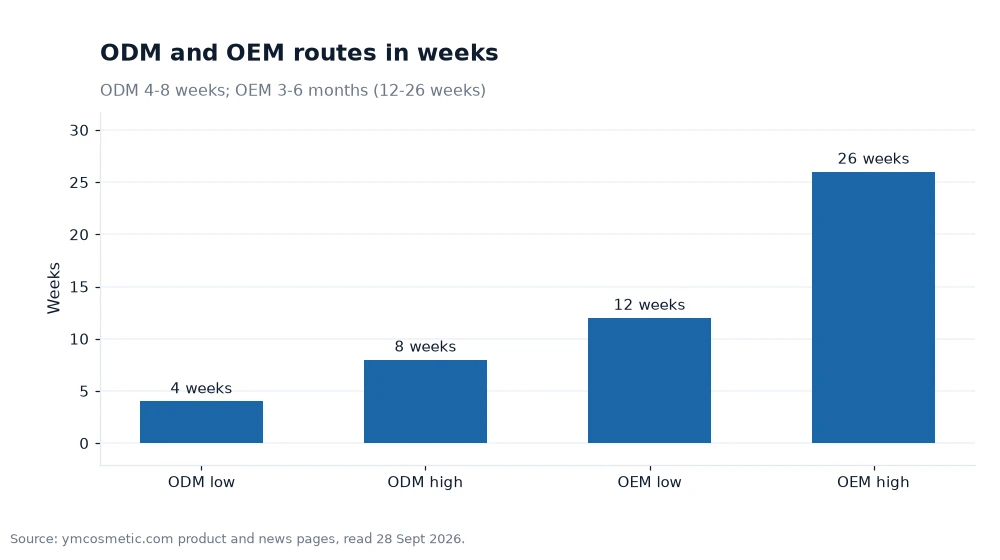
The first pair of bars and the second pair sit in different ranges, which is the decision in one image. Anything inside eight weeks has to reuse a base; anything beyond three months can afford new development. Deadlines that fall in the space between are the ones where an adjusted library formula, rather than a new system, is the only way to hit the date.
Frequently asked questions
Can the long route be shortened by paying more?
Partly. Packaging and filling can be prepared in parallel and sourcing can be accelerated, but the stability window is set by the formula and the pack rather than by the fee. A route quoted at three to six months is usually already assuming parallel work.
Does a larger order take longer to produce?
The production step scales with quantity, but it is a small part of the total. The route decision — library base or new development — moves the date far more than the batch size does.
When should the packaging be ordered?
As early as the pack is fixed, and ideally before the formula work finishes. Packaging lead time is one of the three factors that stretch a project, and it is the one most often started after the formula is approved.
Choosing the route before the quotation
Decide the route, then ask for a date rather than a duration. A supplier who can name the week your sample is poured and the week your batch is filled is easier to plan with than one who quotes a range. The comparison of private label skincare manufacturers China buyers work from puts the same timeline questions to ten named companies, and Yunmei's OEM/ODM manufacturing service pages set out the two routes alongside the sampling process. Where the first product is a wash-off formula, the cleanser range shows which parts of the schedule change.
What comes from the manufacturer's own website ymcosmetic.com, read on 28 Sept 2026: the four development windows, the order band and the three schedule factors. Converting those windows into days and subtracting them is mine.[1].