A pre-shipment inspection report is useful only when its scope, sample, criteria, and findings are clear enough to support a decision. Buyers should confirm that it covers the correct order and product revision, read the inspection method and exceptions, compare results with written acceptance criteria, and document who may release or hold the shipment. A report records checks performed; it does not replace the buyer’s responsibility to decide what unresolved risks mean.
Key takeaways
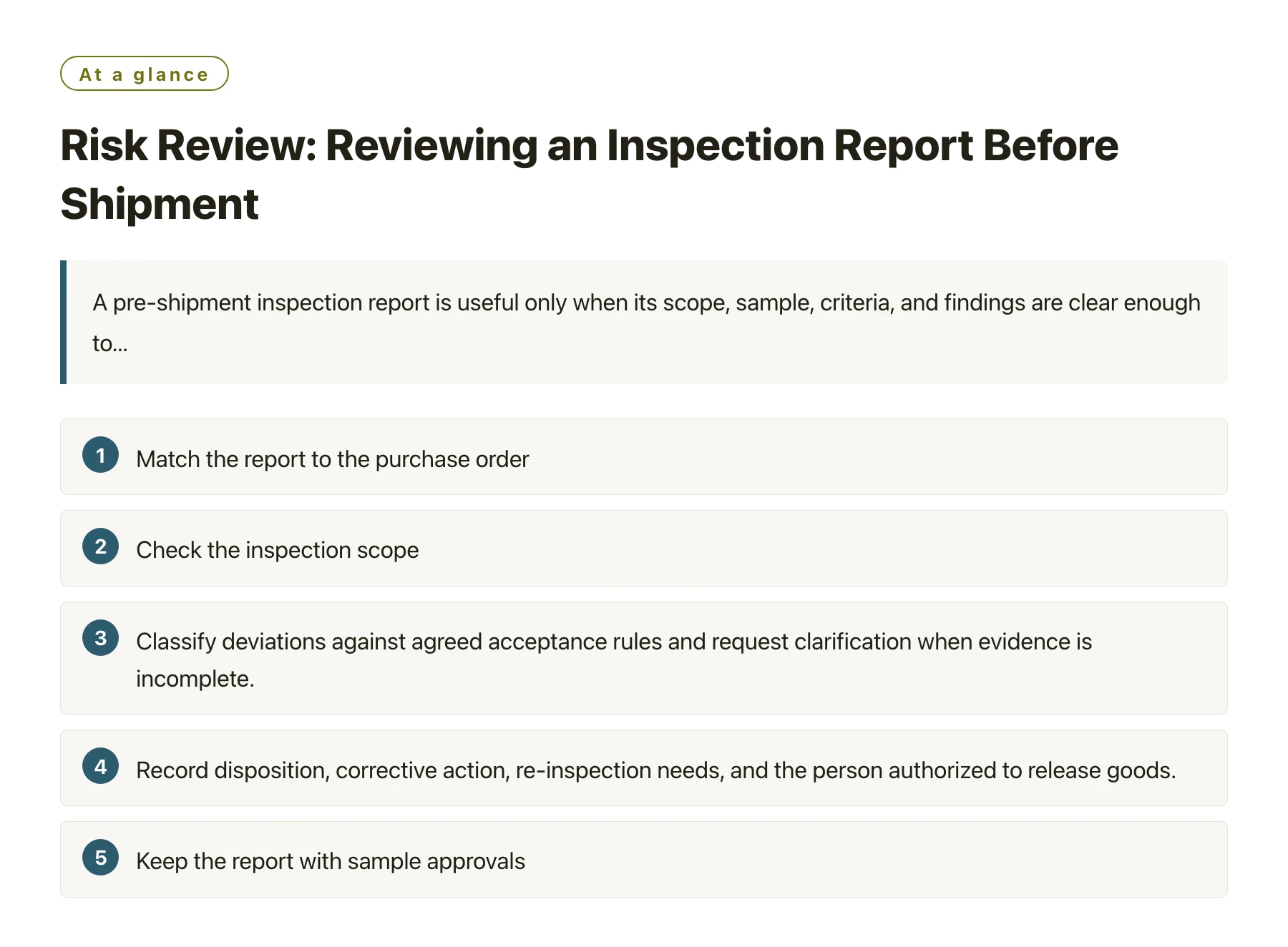
- Match the report to the purchase order, supplier site, model, revision, and quantity.
- Check the inspection scope, sampling method, criteria, date, and evidence for each finding.
- Classify deviations against agreed acceptance rules and request clarification when evidence is incomplete.
- Record disposition, corrective action, re-inspection needs, and the person authorized to release goods.
- Keep the report with sample approvals, production records, shipping documents, and any follow-up.
Review the report before the cargo is handed to the carrier, while there is still time to investigate and make a controlled decision.
Start with identity and scope
Confirm the report names the correct supplier, production location, buyer, order or purchase-order reference, product name, model, and revision. Check that the inspection date falls within the relevant production and packing window. If the report covers only a portion of a multi-item order, identify which SKUs, colors, sizes, cartons, or lots were included and which were not. A correct-looking document attached to the wrong order cannot support the intended release decision.
Compare the reported quantity with the order and actual production status. Determine whether inspection occurred after final packing, before packing, or at another stage. For a packed-goods inspection, confirm that carton selection and opening procedures are recorded where they matter. If only loose units were examined, packaging condition and pack-out remain open questions. Ask the inspector to explain any scope limitation instead of assuming that “passed” covers unobserved work.
Buyers looking for coordinated inspection support can JS Sourcing. Whatever workflow is used, the inspection request should be agreed before the visit: what is checked, where, how samples are selected, which documents are reviewed, and how nonconformities are reported. A clear request makes it possible to tell whether the completed report actually answers the buyer’s questions.
Read the method before the result
Find the sampling plan or the report’s description of how units were selected. Note the lot size, sample size, selection method, and whether the method was agreed in advance. Sampling is a way to examine a defined subset under stated rules; it is not a direct observation of every unit. If the sample is too small for the buyer’s decision or the order configuration is uneven, consult the quality owner about additional checks before relying on the conclusion.
Review the checklist and acceptance criteria. They may cover workmanship, dimensions, function, appearance, quantity, packaging, labels, or accessories. Compare the exact criteria with the approved specification and sample. Generic phrases such as “good quality” are difficult to act on because they do not state what was examined or what variation was acceptable. If a measurement has a tolerance, look for the measured values, instrument or method where relevant, and the specified limit.
Check for context around tests and photographs. A photo can show a condition but may not establish prevalence, cause, or whether other units share it. A measurement should identify the product feature and unit, while a functional check should explain the operation performed. If evidence conflicts with the summary, ask for clarification and retain both the original report and corrected or supplemental record.
Separate defects, observations, and missing evidence
Read every exception, not only the overall status. Distinguish a confirmed defect from a note, observation, measurement pending, document not supplied, or area not inspected. Record the affected model, unit or carton, location, quantity observed, severity under the agreed plan, and evidence. If the report uses major, minor, or critical categories, use the definitions in the contract or inspection criteria; do not infer a universal meaning from the labels.
Compare each deviation with the approved sample and specification. A cosmetic difference may be acceptable under one written standard and unacceptable under another. A missing manual, changed component, incorrect label, damaged retail box, and functional failure have different consequences. Consider product safety, legal obligations, customer use, brand presentation, and downstream rework separately, and route the finding to the person qualified to assess each concern.
When findings involve possible consumer-safety issues, identify the exact model and lot and consult the responsible compliance owner. Public recall notices illustrate why model identifiers and specific hazard descriptions matter: the U.S. CPSC recall database lists product-specific warnings and remedies, and its contents can change over time. It is a reference for safety information, not a substitute for determining the requirements that apply to the buyer’s product and market. [1]
Check whether the conclusion follows from the evidence
A summary status should be traceable to the observed results and pre-agreed acceptance rules. Verify the reported defect counts against the sample size and stated classification method. If results are near a threshold, verify arithmetic and ask what procedure was applied. If the report says pass but lists unresolved deviations, request a written explanation of how those findings were treated. Do not let an unexplained status line override the detailed evidence.
Look for missing sections, unreadable photos, inconsistent product names, blank fields, or evidence that appears copied from another inspection. Check that documents and test records refer to the same factory, model, revision, and market configuration. If laboratory results are cited, review their scope, date, sample identity, and issuing organization through the appropriate compliance process. A factory-level management certificate by itself does not demonstrate that an individual shipment meets product specifications.
For a report that is incomplete, ask focused questions: Which units were selected? What exact defect was observed? Which requirement did it fail? Was rework completed before packing? Can the revised lot be inspected again? Request an addendum or new inspection when the answer changes the release decision. Preserve the chain of versions so internal reviewers can see which document reflects the final evidence.
Decide disposition and follow-up
Use the purchase agreement and quality plan to choose among release, release with an accepted deviation, hold, rework, or further inspection. The decision should name the affected quantity and models, any limits or conditions, and the person authorized to approve it. If a deviation is accepted commercially, capture that acceptance in writing and update the applicable order record. Avoid treating a supplier’s promise to fix an issue as evidence that the correction has already been made.
When rework is required, agree what will change, who will do it, what records will show completion, and whether a re-inspection is necessary. The follow-up should verify the actual corrective action and the relevant product or packaging characteristics. A second report should refer to the original finding and identify the corrected lot or units. If full re-inspection is not feasible, document the residual uncertainty and the basis for the chosen control.
Shipment release should consider more than the inspection outcome. Confirm that required documents, labels, quantity, packing list, carton marks, transport booking, and any market-specific approvals are ready. Define who can authorize dispatch and how the carrier is told if a hold remains. This reduces the risk that an unresolved quality decision is lost between the factory, buyer, inspector, and logistics provider.
Maintain a useful evidence trail
Store the final report with the inspection request, approved specification, sample record, purchase order, supplier correspondence, corrective-action evidence, and release decision. Use a consistent identifier across the product, order, and report. Separate superseded drafts from the final version, and retain original files when a revised report is issued. A concise index lets another reviewer understand what was inspected without relying on informal messages.
After arrival, compare reported observations with receiving checks, damage records, complaints, or returns. Tie any difference to a model, lot, carton, and known handling conditions. If a recurring issue appears, revise the inspection checklist, sampling approach, specification, or supplier process for a later order. Do not generalize a single shipment’s result into an unsupported conclusion about all production by that supplier.
Sources
Frequently asked questions
Does a passed inspection guarantee every item in the order is defect-free?
No. A report describes the scope, sample, criteria, and observations for that inspection. Review the method and limits before deciding what confidence it supports.
What should I do when a report lists defects but says “pass”?
Compare the exceptions with the written acceptance criteria and ask the inspector to explain the status. Record a release, hold, rework, or deviation decision with an authorized approver.
Should shipment be released based only on an inspection report?
Use the report as one input. Also confirm required documents, approved product and packaging versions, quantity, labels, and any compliance or logistics conditions.
When is re-inspection appropriate?
Consider it when rework changes the affected product, the original evidence was incomplete, or the unresolved finding could change the release decision.